
More B2B marketers now answer for outcomes in a way they did not a year ago. In the 2026 B2BMX Insights Benchmark Survey, pipeline influenced became the top metric marketing teams are held to, displacing opportunities generated and MQLs, which led in 2025. The share of teams carrying revenue-based quotas rose from 25.33% to 33.33% in the same span.1 Media buying is moving with them. Marketers can ask a publisher to put money behind a result, and a growing number of publishers are saying yes. When a publisher prices or guarantees media against a result, that is outcome-based advertising, and it is having a moment.
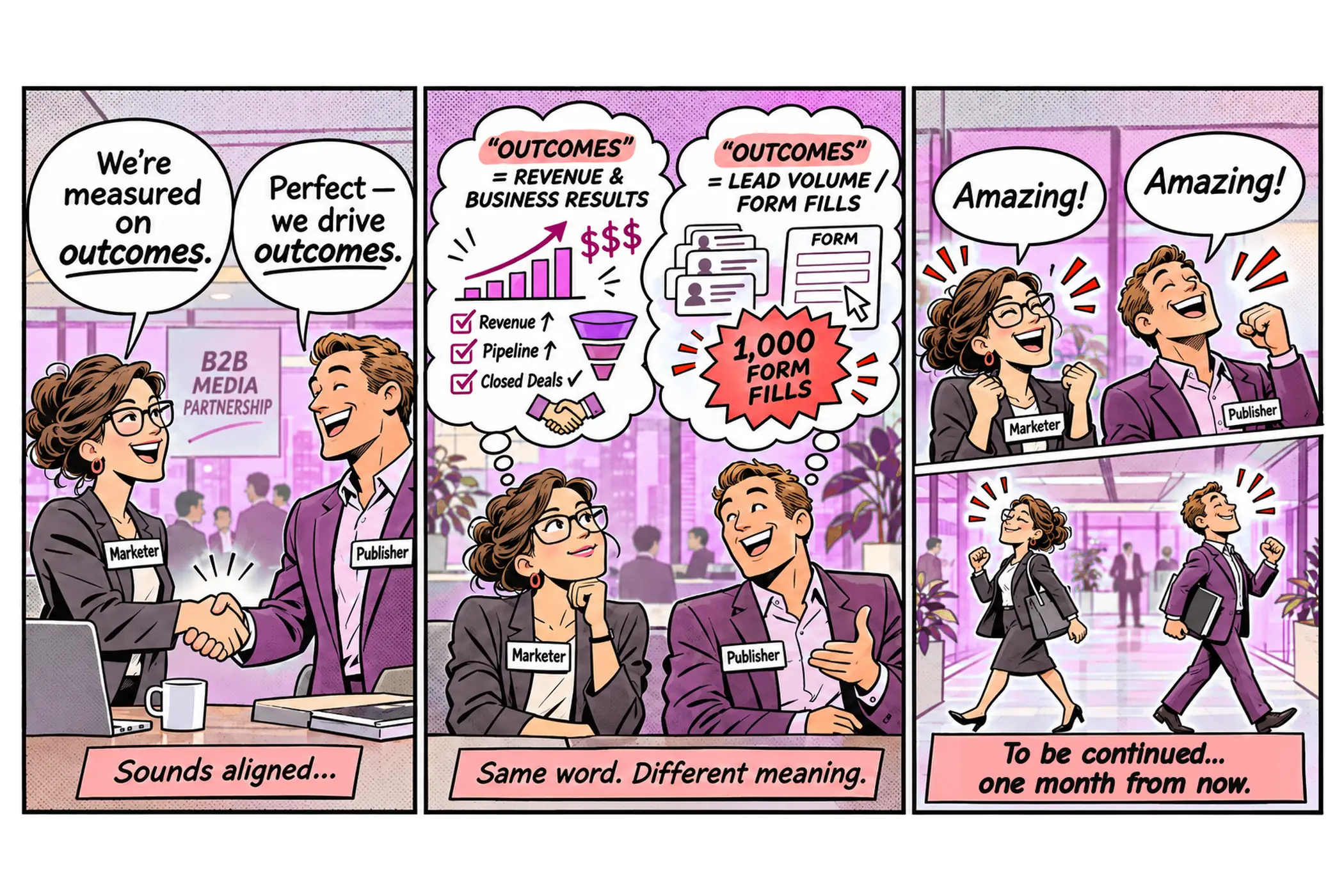
The appetite is clear, even if the definition has stretched to fit it. Outcomes could mean anything from a guaranteed store-visit to a cost-per-lead. It's a fair use of the word, but publishers and B2B marketing teams aren't necessarily working from the same definition. That disconnect is worth naming in an effort to close it.
Why definitions differ based on the outcomes they drive
For marketers, an outcome sits at the end of the funnel in revenue, pipeline and closed business. Teams work backward from that number and judge every channel by how far it moved. They hold publishers to their ability to drive those downstream outcomes.
For publishers, an outcome is often any result a contract can tie to a payment or a guarantee. Under that definition almost every predictive delivery model can claim the label. Most of this once had a plainer name, Performance-based advertising, where "the purchaser pays only when there are measurable results."2
Technically both perspectives hold up, but they start at opposite sides of the same transaction.
Publishers disagree on where an outcomes-based marketing starts
A click qualifies in one pitch and fails the test in the next.
- Leads count. Choozle describes outcomes as "conversions including leads, transactions, revenue, foot traffic" and names lead generation as an immediate outcome.3
- Store visits and purchases count. In TV and streaming, sellers guarantee real-world actions. Digiday notes these sellers are "not so much pledging to generate a specific outcome count as a relative impact."4
- App installs count. LG Ads Solutions launched what it called a "first-of-its-kind suite of guaranteed outcome-based media offerings," with guarantees on app installs and video completion rate.5
- Clicks do not count. One company, Realize, draws the line tighter. It calls outcome-based advertising "a narrower subset" of performance marketing that counts only bottom-of-funnel actions, and it treats CPM and CPC as proxy metrics.6
One word offers three potential promises that shouldn't be positioned as a homogenous body to marketers.
- Optimized toward an outcome. The algorithm aims at the result, but you may still pay per impression or click, as with target-CPA bidding.
- Priced on an outcome. Marketers only pay when the action happens, as with pay-per-lead.
- Guaranteed an outcome. The publisher commits to a result and makes good if it falls short, as with TV lift guarantees.
Each puts the risk in a different place, and that placement tells a marketer what they are really buying.
What marketers actually want from outcomes-based marketing
A year before the B2BMX results:
- A 2025 6sense study of 634 B2B marketers found the most-tracked metrics were marketing qualified accounts at 49% and MQLs at 44%. Pipeline from target accounts came in at 33%, and closed-won deals at 22% or less.7
- Even media buyers outside B2B said the same thing in iSpot's 2025 Upfronts survey, 53% of marketers named outcomes the most critical factor in buying and negotiating media.8
Read together, these findings point one way. Marketers are judged on results closer to revenue every year, and they want an advertising model based on those results because it gives them a number they can plan, defend and forecast.
From a publishing standpoint differentiated and stable approach to engaging with end buyers that ultimately yields a better outcome. Further, when that approach, engagement, or buyer profile changes, they want publishers to be up front and accountable for the impact those shifts have on their goals.
Bridging the gap
The most important way to bridge the gap is to ensure both parties are speaking the same language. Publishers can ask themselves 3 questions before marketing themselves as an outcomes-based:
- Can you name the outcome? State the exact result you will deliver, such as a lead that meets the buyer's criteria, a booked meeting or an install. If you cannot define it in one sentence, the claim is not ready.
- Can you deliver it every time? Check how often past campaigns hit the result the buyer set. An outcome you reach some of the time is a goal, and selling it as a promise costs you the renewal.
- Who pays when it misses? Decide up front whether you price on the result, guarantee it or only optimize toward it, and put that in the contract. Buyers who know the terms at the start come back. Buyers who learn them after a miss move their budget.
Likewise, marketers can set clear expectations for outcomes they want against what publishers can actually guarantee. Three checks make that comparison concrete:
- Which outcome is this budget for? Name the one result you are buying: a qualified lead, a booked meeting, pipeline or revenue. Each comes a different number of steps after the ad or engagement tactic. The more steps between that first touch and the result, the less any publisher controls it.
- What can the market guarantee against it? Very few publishers can guarantee revenue, because too much happens after the handoff to sales. Most can guarantee an earlier step, such as a lead that meets your criteria, and set you up with the best odds of reaching revenue from there.
- Do the economics hold? Price the guaranteed step against your own conversion rates further down the funnel. When the cost of each guarantee still works at your lead-to-pipeline rate, the publisher serves the outcome you need.
Outcome-based advertising works best as a shared agreement. When marketers name the result they need and publishers promise only what they can deliver, the word stops being a buzzword. It becomes a number both sides can plan around and defend.
Audyence, B2B's first and only programmatic marketplace for pay-per-lead inventory, guarantees leads at up to 47% lower rate compared to brokers by taking you direct to verified lead suppliers. You set the lead criteria, they deliver against them, and you pay for the leads that meet them. That puts both checklists above into one transaction. Marketers name the outcome before the campaign starts, and publishers commit only to the leads they can deliver. Both sides work from the same definition, which is where outcome-based advertising starts to earn its name.
Sources
1 Demand Gen Report and B2BMX Insights, "The 2026 B2BMX Insights 2026 Benchmark Survey Results: B2B Marketing Enters the AI Era." Sample size and fielding dates in the gated download.
2 "Performance-based advertising," Wikipedia.
3 Choozle, "Outcomes-Based Advertising: A Paradigm Shift in Marketing."
4 Tim Peterson, "WTF are outcome-based measurement guarantees?" Digiday, February 26, 2024.
5 "Satisfaction Guaranteed? The Growing Appeal of Outcome-Based Advertising," VideoWeek, February 28, 2022.
6 Realize, "Outcome-Based Advertising: From Clicks to Measurable Outcomes."
7 6sense, "What's (Currently) Measured Isn't What Matters: The State of B2B Marketing Metrics in 2025," June 16, 2025. n = 634 B2B marketers, fielded early 2025.
8 iSpot 2025 Upfronts survey, as reported by The Measure, May 13, 2025. Sample size not published.