
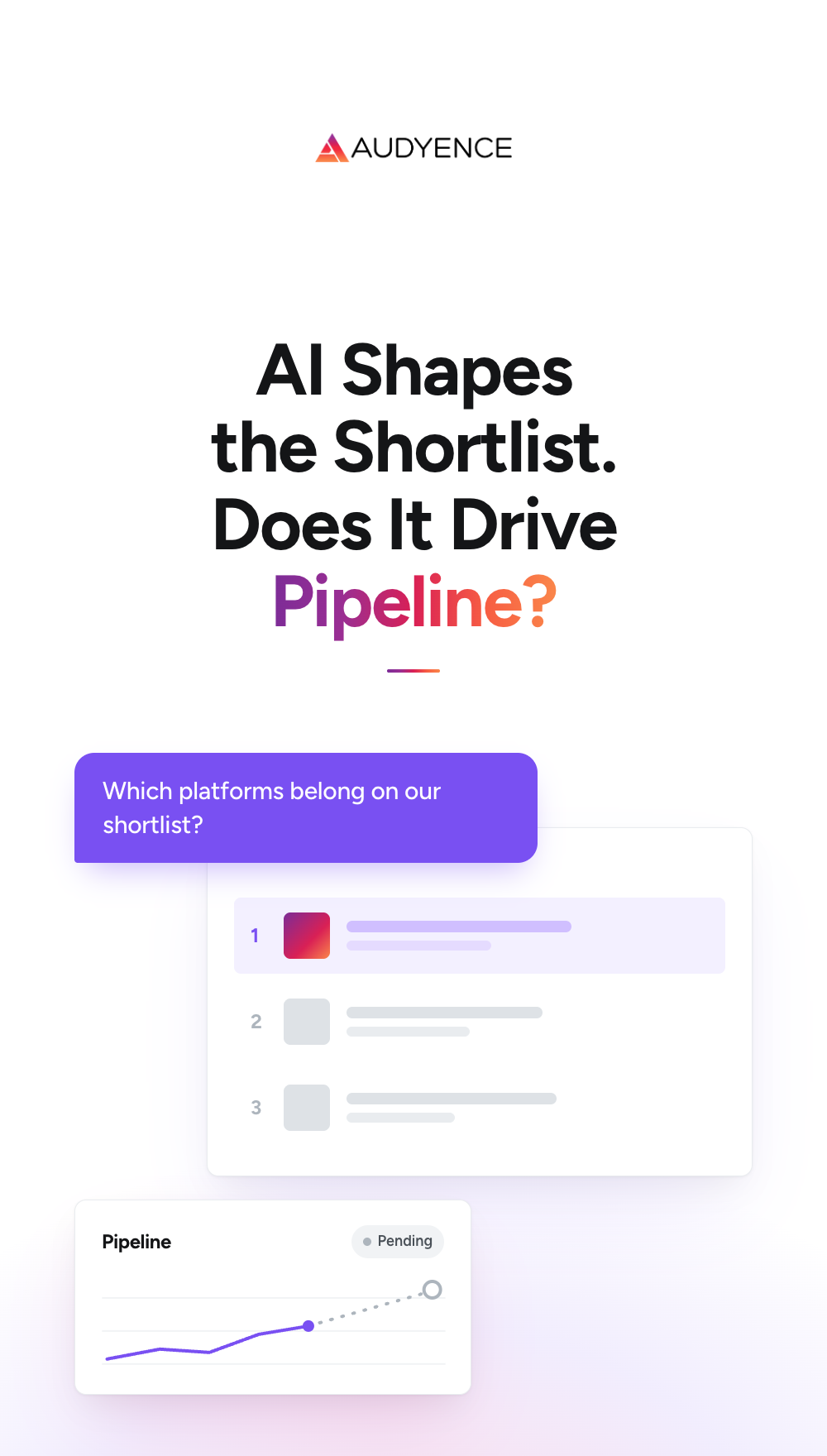
Buyers have a new first stop. Eight in ten B2B buyers used AI chatbots to source software recommendations in the last 24 months, according to G2's 2026 Buyer Behavior Report.1 The shortlists those buyers built tend to hold. Among AI users, 80% bought from their initial shortlist in at least three of their last five purchases.1
That moves the starting line of a deal. It also raises a question every demand team will want answered. Is the content that earns a spot on the shortlist the same content that gets a vendor chosen?
What AI likes to cite
Nearly two-thirds of B2B citations come from conversations happening off a company's own site. In Meltwater's analysis of 9.5 million AI citations across 16 B2B categories, platforms like LinkedIn, Reddit and YouTube drove 47.5% of citations. Company websites drove 18.7%, and peer review sites drove 15%.2
Each of those sources carries a different kind of content. Review sites like G2 hold profiles, ratings and side-by-side comparisons that follow a set format. YouTube holds thought leadership, demos, and explainers. LinkedIn is the most freeform of the group, and it's where marketers publish and promote much of the content they create themselves.
Meltwater and LinkedIn looked at the LinkedIn articles AI engines cite most.3 The winners read like a brief written for a buyer in the middle of a decision:
- "Best X" listicles: 54% of top-cited articles
- Side-by-side comparisons: 50%
- "How to choose" guides: 33%
- Educational explainers: 17%
- Thought leadership with data: 8%
The pattern is easy to read. AI favors content that answers a buyer's shortlist question in a form it can lift and quote. Every top-cited article used lists. 92% used clear section headings, 75% named specific companies or tools, and 67% included hard numbers.3 In other words, structure carries as much weight as subject. Marketer-made content is where teams have the most freedom to act on that, and the least certainty about the payoff.
Does AI-cited content drive pipeline?
Once a buyer raises a hand, the work changes. For 40% of buyers, the second stage, evaluation, is now the longest stage of the purchase, ahead of research (36%) and decision (22%).1
That second stage is where the formats B2B marketers know best still do their best work. The report, the benchmark, the ROI case and the webinar give every person on the buying committee something specific to weigh. But many teams put their deepest evaluation content behind a gate, which keeps it out of AI's reach.
Our read is that the formats still work. What needs to change is how they're packaged and where they're distributed. A citation study can't confirm that on its own. That takes conversion data: which assets a known buyer touched before the deal became pipeline.
The question we want answered
Three questions sit underneath this data:
- Does the content AI cites match what B2B marketers use to engage buyers today?
- Does it look like the content that converts a known buyer on a page?
- Where the lists differ, is that a gap to close, or two jobs that need each other?
3 steps to answer these questions in your own funnel
Marketers don't need to wait for a published study to start understanding if their content funnel is built to do multiple jobs.
Step 1. Spot the gaps in your funnel by tagging your content according to stage:
- Discovery assets: open, structured for AI, and specific. Built around the questions a buyer asks while forming a shortlist.
- Evaluation assets: deep and data-rich. Built for every seat on the buying committee, and worth a form fill.
- Decision assets: proof the whole committee can sign off on. ROI cases, customer stories and clear pricing give finance and every other approver a reason to say yes.
Step 2. Find out which content creates pipeline by following each asset past the form. Check which assets show up in opportunities that closed, by job level and industry. An asset with plenty of form fills and little pipeline is usually discovery content sitting behind a gate.
Step 3. Learn what the buying committee relied on by asking the people who bought. In win/loss conversations, ask what they read, what they shared with the rest of the buying committee and what finance needed to approve. Compare that list to the content you gate today.
Run all three and you'll know whether your shortlist content and your pipeline content do the same job, or two jobs that need each other.
Join the Demand Innovation conversation
Demand Innovation is more than our tagline. It's a movement, and we're glad to be part of it. Watch the Demand Innovation Series for more perspectives on how B2B marketing is changing.
Sources
1 G2, 2026 Buyer Behavior Report. Survey of 1,038 B2B decision-makers, fielded June 2026.
2 Meltwater, "LinkedIn is the #2 most-cited source in AI answers, new Meltwater report finds," press release, May 12, 2026. Analysis of 9.5 million AI citations across 16 B2B categories.
3 Meltwater and LinkedIn, "New Meltwater research shares 5 insights from 9 million citations," LinkedIn Marketing Blog. Structural figures based on the top 24 most-cited LinkedIn articles.