

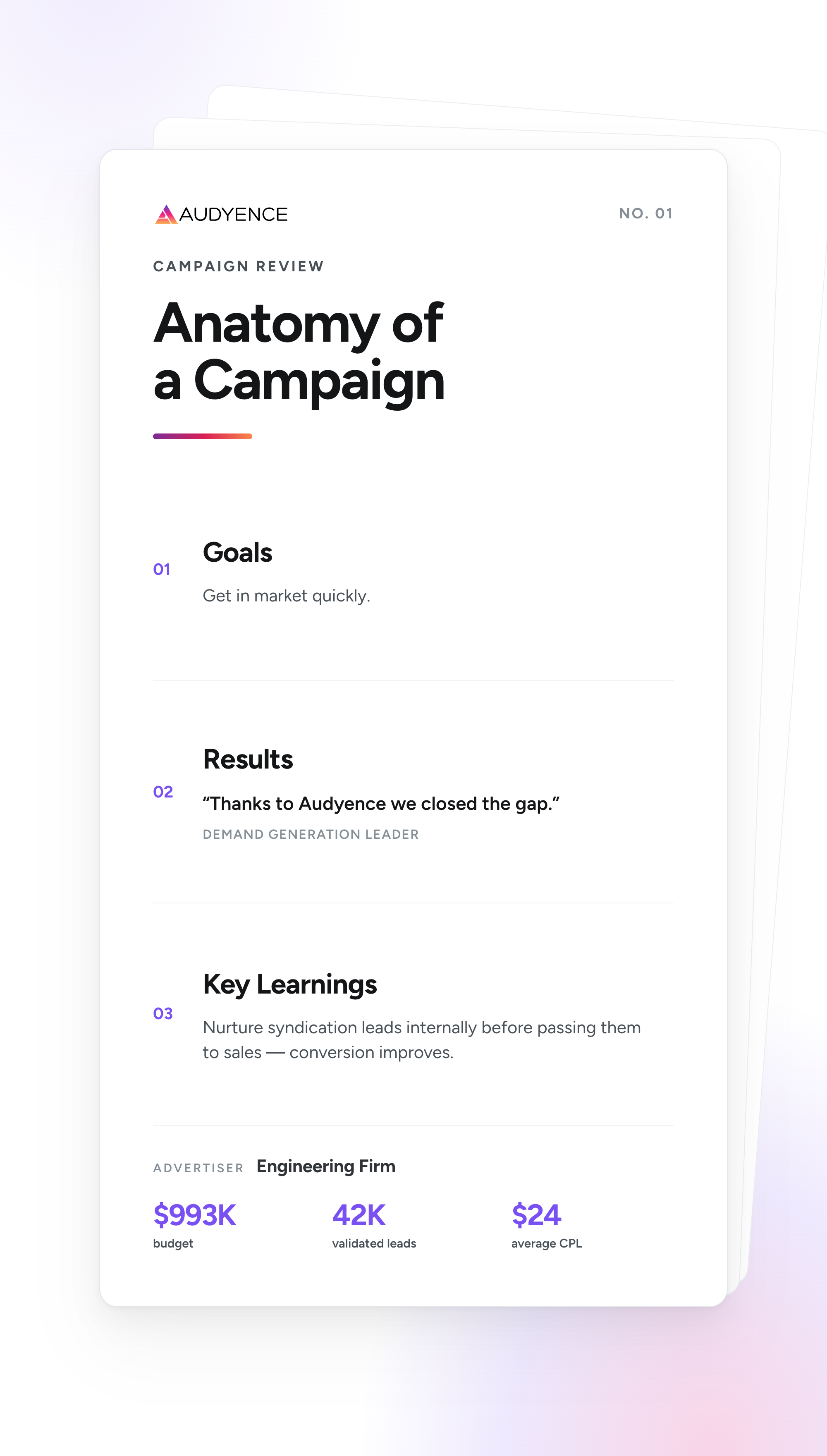
Introducing the Anatomy of a Campaign Series
This is the first in a series of real campaign stories. What an advertiser set out to do, what they built, whether they got there, and what they learned on the way.
Every story in this series is here to share real world experiences that can help you achieve your goals whether you're:
- Balancing your budget for programs with the operational needs of your team
- Shifting spend toward what is converting in real-time
- Getting a campaign in market while you have a strategic advantage
- Ensuring your leads live up to your data quality standards
- Handing sales leads they will actually work
First up, a team that brought its program in-house and rebuilt the sales handoff along the way.
5 Things to Successfully Bring Your Lead Generation Campaigns In-House
A global technology and engineering company brought its lead generation program in-house. They chose to work with Audyence to de-risk that transition with workflow automation, source testing, and transparent pricing. Nine months later the team was running more than twenty concurrent campaigns and getting a program from request to live in two days without adding headcount.
The Campaign
They ran an account-based program for new logo acquisition, targeting buying groups of engineers inside the companies they wanted to win. They promoted technical PDFs, whitepapers and webinars built around a new product line these engineers buy. Engineers are marketing-averse, so the asset had to be worth the form fill.
They ran more than twenty campaigns at once, one per country across the US and EMEA. Quarterly budget expired if it went unspent, so every week between plan and launch was money they would never get to use.
Goals
They needed to build and feed the sellers' demand waterfall with new buying groups identified inside new accounts, responses, and eventually conversions. They also needed to be able to spend whatever budget came their way before it expired. Sales cycles run six to eighteen months, so interest generated now pays off later.
Getting Started
They started a $70,000 pilot to run for three months. The team built and launched over 20 localized campaigns in two weeks, and each one went live in two days.
Their first learning came quickly as they saw leads delivered in real time. Their targeting needed to be updated to pull in the right titles. Using "data acquisition" pulled in information technologists, so they switched to language that better described the work their engineering audience was doing: test and measurement, data acquisition. The Audyence platform helped them make that pivot in real time, so the leads that were going straight to sales actually represented their target buyers.
What the results showed
The pilot delivered, and the companies and titles came back clean enough that lead review stayed light. But, sellers worked them and found almost none were ready to talk. They recognized that these buyers had shown interest in their products, but they may require nurture before proceeding to sales.
Rebuilding the handoff
The team built email nurture tracks of four to seven touches, not one or two. Non-openers got a second run at a different subject line. The copy named the piece someone downloaded, because most people did not remember filling out the form. It read like a person wrote it, because aerospace, defense, government and semiconductor accounts blocked anything that did not.
Leads sat in those tracks until an engagement threshold got crossed, then routed to a seller. The threshold still got crossed. It just took longer, and more buyers reached a sales-ready conversation than the direct handoff produced.
That performance earned them incremental budget, on use-it-or-lose-it terms. It had to be live within two weeks and spent by the end of the month.
"We, we reached our goals as far as the volume. We knew that we had so little time and we were like, are we going to be able to deliver all of this in one month?"
Spoiler alert. They did, and two-day launches made that possible. They kept every dollar.
Where it landed
Nine months in, their program grew to $993,000. Roughly 42,000 leads were delivered, and nearly 11,000 more were rejected by platform validation before the team ever saw them. The team was thrilled to achieve an average CPL of $24 and reinvested part of the savings back into their programs.
Content syndication earned a permanent place in their core channel mix once they saw how many buyer touch points ended in a sale.
The move in-house gave this team the controls they needed to move quickly without adding headcount. And, the nurture they built before the sales handoff is what turned it into a channel they kept.
Five things to take with you:
1. Know your buyer well enough to pick content they want.
Titles aren't a bullet-proof targeting tool. Match your targeting descriptions to the person doing the work. Know which one you are talking to and you can put the right asset in front of them.
2. Minimize your time out of market.
Every day a campaign is not running is opportunity cost against your pipeline, and against budget that expires whether you spend it or not. Partner with platforms that can get you live fast.
3. Engage content syndication leads before you send them to sales.
A download is one engagement. That is real interest, but it's not a signal that someone is ready to buy right now. Running leads through a nurture track is not just recommended, it's critical if you want to build a relationship and earn the consideration of your buyers.
4. Reference the content they downloaded, in real words.
Most people do not remember filling out the form. Name the piece they asked for, and write it the way a person would write it, because plenty of industries now block anything that reads as machine-written.
5. Don't give up after one touch.
One or two emails will not move a buyer who is nine months from a decision. Size the track to the cycle you actually sell.
Ready to run lead generation with the controls in your hands? Request a demo →

.png)

.png)